
Prolonged consumption of excessive alcohol leads to heightened enzymatic activity for alcohol breakdown, placing increased demand on the liver, ultimately impairing its function and its capacity to metabolize acetaldehyde. As a result, constant changes in liver cells occur, leading to degeneration and necrosis of hepatocytes and fibrosis, and liver function declines, which causes alcoholic liver dysfunction.
Alternatively, fucoidan, which originates from brown algae, has undergone significant study for its array of biological activities, notably its anticoagulant, antithrombotic, antitumor, antiviral, anticomplementary, and anti-inflammatory properties.
In this blog, I would like to share the following study, “Fucoidan from Fucus vesiculosus Protects against Alcohol-Induced Liver Damage by Modulating Inflammatory Mediators in Mice and HepG2 Cells” by Jung Dae Lim et al.
The study began with the use of alcohol as a means to induce liver problems. For one week, mice received daily intragastric administrations of 25% alcohol (5 g/kg body weight) along with varying amounts of fucoidan (0–60 mg/kg). Once the experiment was concluded, the weights of the liver, spleen, and thymus were meticulously recorded. The alcohol-treated group had enlarged livers compared with the control group. Mice consuming alcohol had increased liver weight, but significantly decreased thymus weight. Alcohol has been suggested to cause thymus atrophy, possibly by promoting thymocyte death.
In addition, fucoidan administration halted the reduction in thymus weight caused by alcohol. Administration of fucoidan alone increased the organ weights of the liver, spleen, and thymus. It is unclear why the administration of fucoidan alone led to increased organ weights; this effect may be related to nutritional supplementation or to the cytoprotective effects observed in mice.
The assessment of alcohol-induced liver injury involved measuring serum aspartate aminotransferase (AST/GOT) and alanine aminotransferase (ALT/GPT) with a colorimetric approach. In the fucoidan-only treatment group, no significant differences were observed in serum AST (vehicle 40.0 ± 2.56 U/L vs. alcohol 58.68 ± 11.12 U/L, p < 0.05) and ALT (vehicle 50.0 ± 3.56 U/L vs. alcohol 71.16 ± 4.71 U/L, p < 0.05). Significant increases in AST and ALT, reflecting liver injury, were observed in alcohol-fed mice, but these increases were significantly suppressed in the presence of fucoidan. The observed increase in liver weight within the fucoidan-only treatment group, as indicated by these findings, might not stem from liver damage. Instead, it could be a consequence of fucoidan’s positive impact on liver health.
To assess alcohol-induced liver injury, serum aspartate aminotransferase (AST/GOT) and alanine aminotransferase (ALT/GPT) were measured using a colorimetric method. In the fucoidan-only treatment group, no significant differences were observed in serum AST (vehicle 40.0 ± 2.56 U/L vs. alcohol 58.68 ± 11.12 U/L, p < 0.05) and ALT (vehicle 50.0 ± 3.56 U/L vs. alcohol 71.16 ± 4.71 U/L, p < 0.05). Significant increases in AST and ALT, reflecting liver injury, were observed in alcohol-fed mice, but these increases were significantly suppressed in the presence of fucoidan. It appears from these results that the augmentation of liver weight in the fucoidan-only treatment cohort may be linked to the advantageous effects of fucoidan on the liver, as opposed to liver injury.
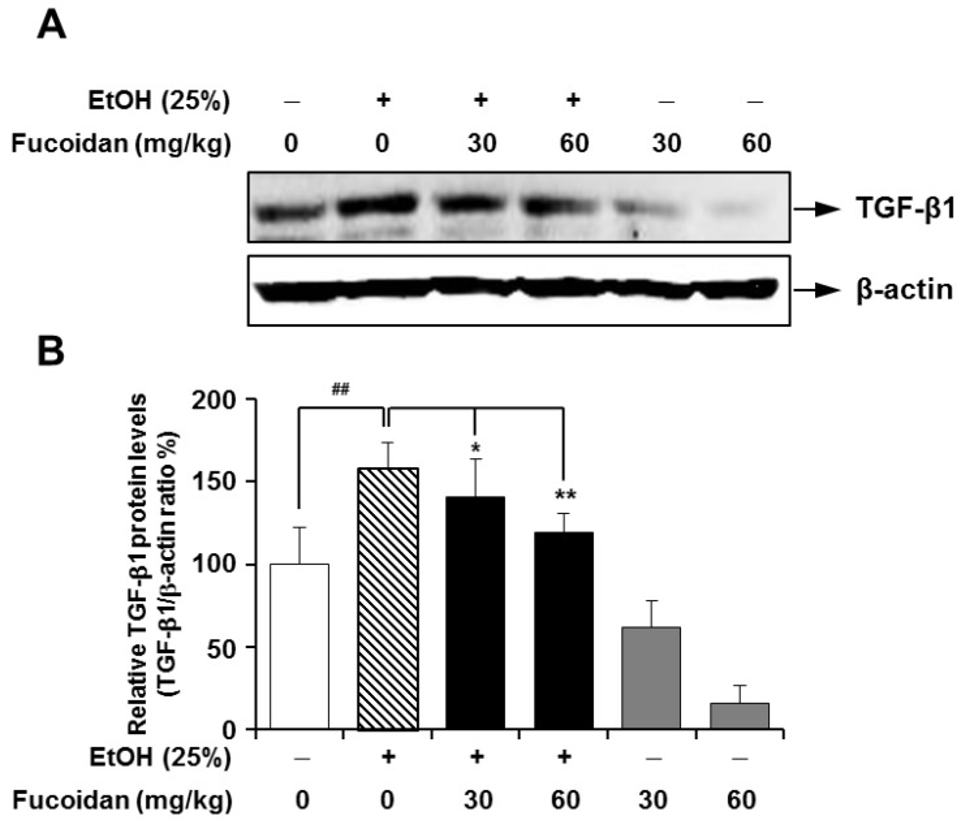
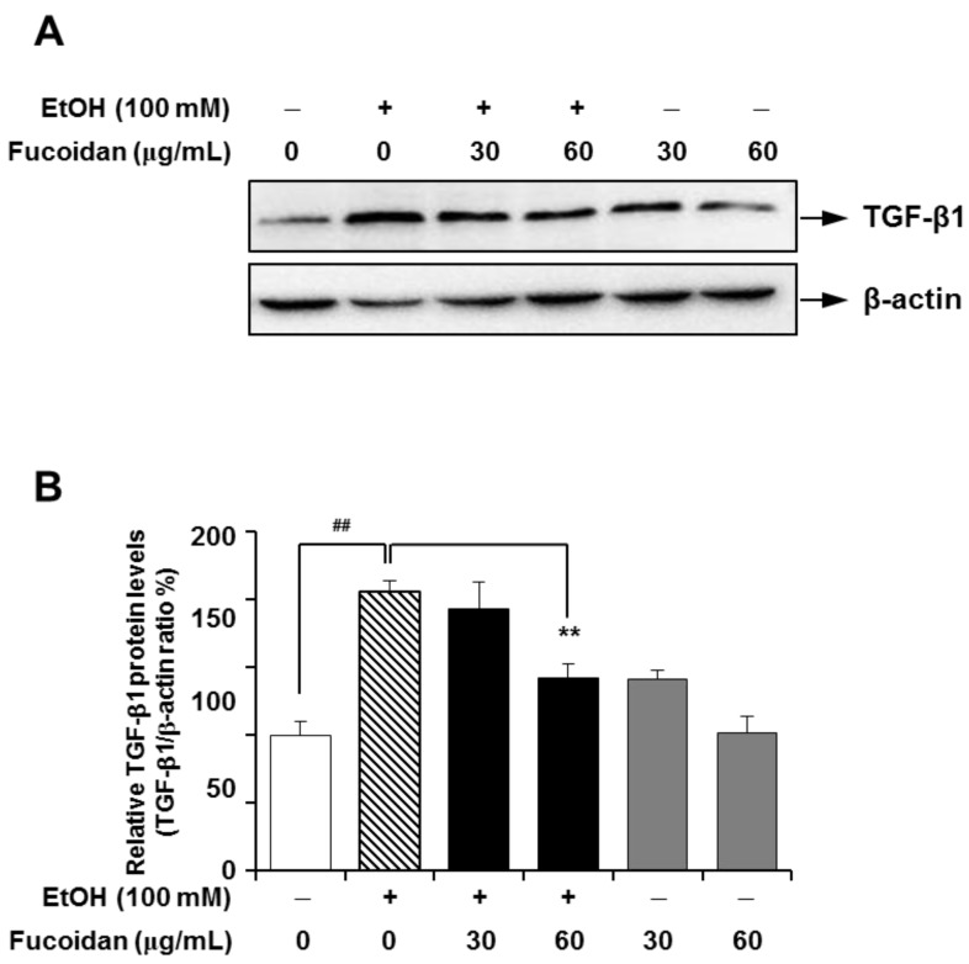
Inhibition of TGF-β1 activity has proven effective against fibrotic responses to injury in various organs. Alcohol induced a significant increase in TGF-β1 expression, whereas administration of fucoidan to alcohol-fed mice attenuated TGF-β1 expression, as shown in Figure 1. This inhibitory effect of fucoidan on alcohol-induced TGF-β1 upregulation was further tested in HepG2 cells, a cell line suitable for studying polarized human hepatocytes. As shown in Figure 2, TGF-β1 expression levels in HepG2 cells significantly increased after alcohol exposure, and this increase was also suppressed in the presence of fucoidan. As illustrated in Figures 1 and 2, fucoidan on its own led to a decrease in TGF-β1 expression in both mouse liver and HepG2 cells. This indicates that fucoidan might possess a broad inhibitory effect on TGF-β1 expression.
Alcohol consumption has been reported to increase NO production in rat livers. Therefore, they evaluated the modulatory effect of fucoidan on ethanol-mediated NO production in HepG2 cells. NO significantly increased in HepG2 cells after alcohol exposure, and this increase in NO production was significantly attenuated in the presence of fucoidan. Since NO production after alcohol exposure may be enhanced by an increase in iNOS enzyme activity or protein expression level, they measured iNOS protein expression levels in mouse livers and HepG2 cells and found no significant changes in iNOS expression. While it is unclear why iNOS expression levels remained unchanged despite increased NO production after alcohol exposure, they speculate that NO production is not mediated by increased iNOS expression. Despite this, iNOS activity can be improved without any modifications to protein concentrations. In the study, fucoidan suppressed alcohol-induced NO production in hepatocytes, suggesting that fucoidan may have another beneficial effect on alcohol-induced hepatic inflammatory responses.
COX-2 is a key enzyme in the prostaglandin biosynthesis pathway. During liver inflammation, COX-2 levels increase, and the production of eicosanoids plays a substantial role in liver damage. Furthermore, COX-2 may play a role in the progression of liver fibrosis. In lipopolysaccharide (LPS)-exposed rats, selective inhibition of COX-2 protected against LPS-induced enhancement of allyl alcohol hepatotoxicity. The alcohol-treated group exhibited significantly increased COX-2 expression within our experimental setup. Alcohol-induced upregulation of COX-2 expression was significantly suppressed in the presence of fucoidan. The inhibitory effect of fucoidan on COX-2 expression was more pronounced in alcohol-treated HepG2 cells. Fucoidan’s proven ability to suppress COX-2 expression in cases of alcohol-induced liver damage suggests its potential as a helpful therapy for inflammatory liver conditions linked to alcohol consumption.
More recent scientific investigations have proposed that the HO-1/nuclear respiratory factor-2 (Nrf-2) pathway offers a form of protection when the body is exposed to oxidative stress caused by substances such as ethanol, carbon tetrachloride (CCl4), and/or diallyl disulfide. HO-1 induction contributes to the inhibition of hepatic inflammatory mediators, such as iNOS and COX-2, through the regulation of JAK-2/STAT-1 signaling. New findings suggest that HO-1 induction defends the liver from ethanol-triggered inflammation through an increase in the downstream mediator carbon monoxide. Carbon monoxide is one of the key regulators of signaling pathways controlling hepatic inflammatory responses, such as MAPK and Egr-1.
While HO-1 expression levels were unchanged by alcohol exposure, fucoidan supplementation increased HO-1 expression levels in mouse livers in the presence or absence of alcohol. The investigative findings also revealed that fucoidan elevated HO-1 expression in HepG2 cells. However, unlike alcohol-exposed mouse livers, HepG2 cells treated with alcohol alone showed increased HO-1 expression compared to controls. The divergent physiological environments of the in vivo and in vitro systems may account for this discrepancy. Although this study did not directly address the mechanism of HO-1 induction by fucoidan, these molecular mechanisms may be involved in the process.
The results suggest that fucoidan supplements protect against ethanol-induced liver damage. This protection occurs by reducing the liver’s production of inflammatory cytokines like TGF-β1, COX-2, and NO. Additionally, fucoidan bolsters the body’s antioxidant defenses by activating the HO-1 pathway. The protective function of fucoidan in cases of alcohol-induced liver injury, along with its related mechanisms, still needs more extensive study.
Source: Mar Drugs. 2015 Feb 16;13(2):1051–1067. doi: 10.3390/md13021051