
Deep vein thrombosis (DVT) is a serious condition linked to inflammatory clotting, posing a life-threatening risk as part of venous thromboembolism (VTE). It commonly presents with lower limb swelling, pain, and ulcers, and is a significant global cause of mortality. Studies have shown that S100A8/A9 is significantly elevated in DVT patients and is closely associated with platelet activation and NET formation.
Recent research has uncovered that S100A8/A9, also referred to as calprotectin, acts through a new mechanism where the S100A8/A9-GPIbα pathway stimulates platelet production, leading to the formation of blood clots. Fucoidan, a polysaccharide from brown algae, has shown potential anti-inflammatory and heart-protective benefits in prior studies.
This blog post will discuss the study “Low-Molecular-Weight Fucoidan Inhibits Thrombo-inflammation and Ameliorates Deep Vein Thrombosis via Targeting S100A8/A9” by Yiting Feng et al.
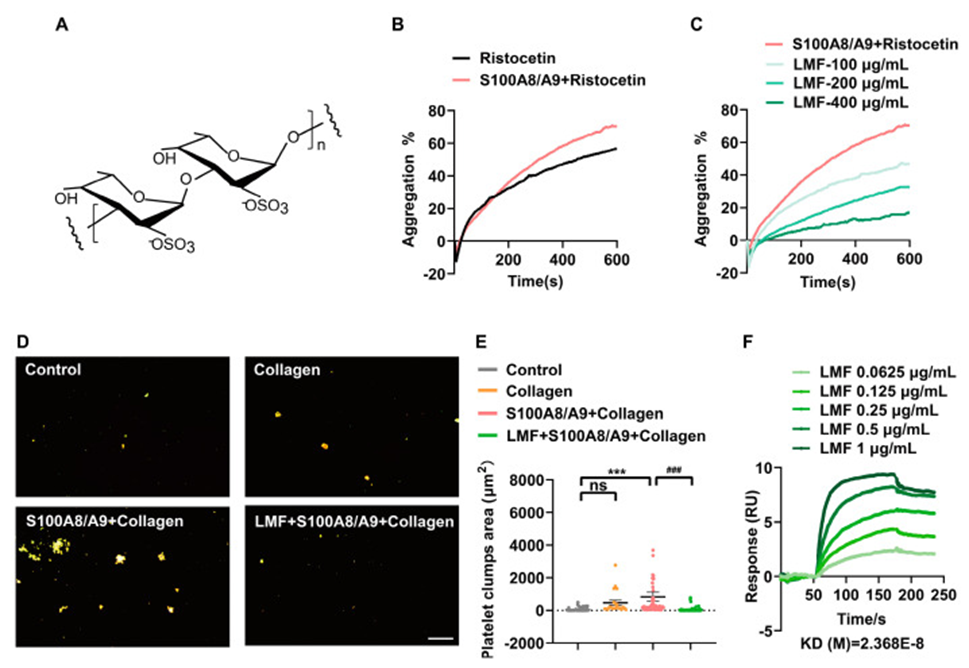
Initially, to determine if S-fucoidan (as depicted in Figure 1A) suppresses platelet activation that is amplified by S100A8/A9, the researchers analyzed the impact of hydrolyzed low-molecular-weight fucoidan (LMF) derived from Fucus vesiculosus on platelet aggregation. The researchers observed that S100A8/A9 boosted platelet aggregation triggered by ristocetin (an antibiotic that causes platelets to clump together by facilitating the binding between von Willebrand factor (VWF) and the glycoprotein Ib (GPIb) receptor on platelets), as shown in Figure 1B. They found that LMF reduced the platelet aggregation induced by the ristocetin/S100A8/A9 mixture in a way that depended on its concentration, as depicted in Figure 1C. Furthermore, LMF substantially inhibited the aggregation of platelets, which was triggered by the combined action of S100A8/A9 and collagen (as illustrated in Figures 1D and E). Surface plasmon resonance (SPR) was used to further demonstrate a direct interaction between LMF and S100A8/A9 (Figure 1F). These results suggest that LMF may act as an antagonist of S100A8/A9-enhanced platelet aggregation by binding to S100A8/A9.
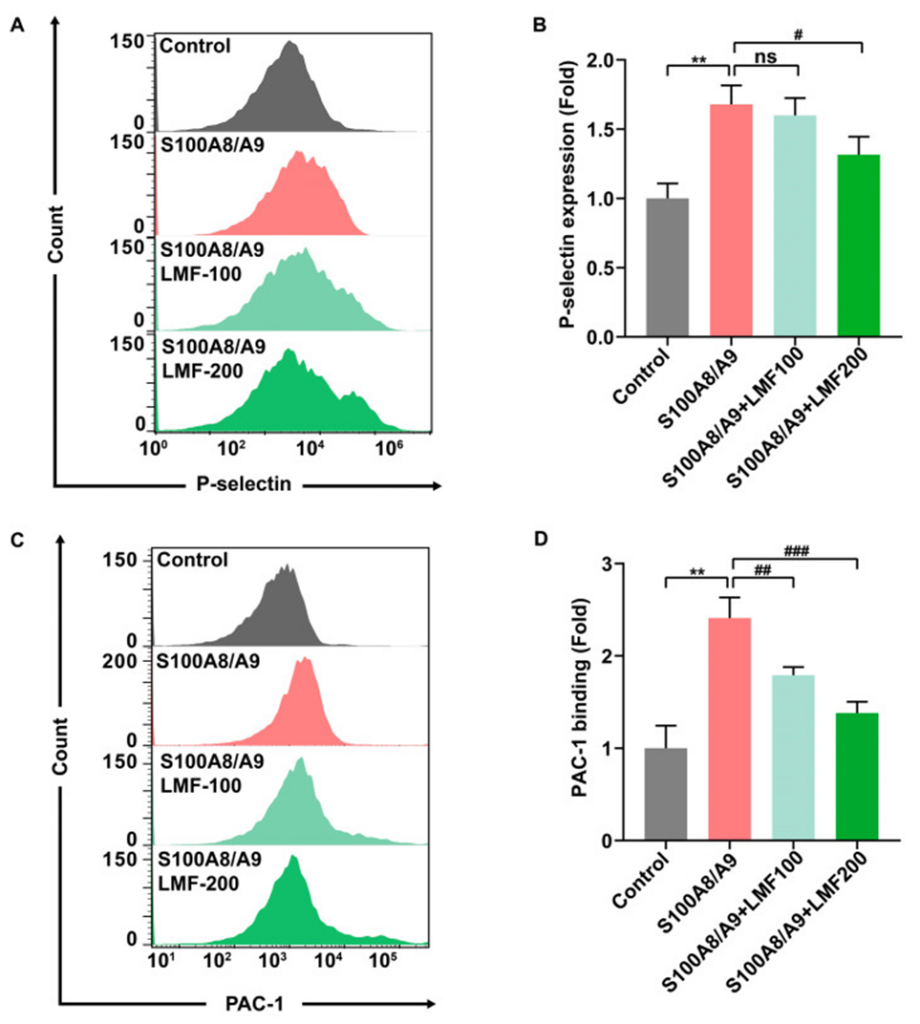
Numerous studies have shown that S100A8/A9 induces α-granule secretion and rapid activation of integrin αIIbβ3 in platelets, promoting platelet activation and platelet-related inflammation. To evaluate the effect of LMF on S100A8/A9-induced platelet activation, flow cytometry analysis was performed. P-selectin, a classical biomarker of platelet secretion, was used as an indicator. As depicted in Figure 2A and B, LMF markedly suppressed S100A8/A9-stimulated platelet degranulation, demonstrated by diminished P-selectin expression on platelets. Furthermore, LMF reduced the binding of PAC-1, a monoclonal antibody that specifically recognizes allosterically activated αIIbβ3, to platelets (see Figure 2C, D). These results indicate that LMF inhibits S100A8/A9-induced platelet activation and secretion.
Increased levels of S100A8/A9, along with platelet activation, are connected to deep vein thrombosis (DVT). To study how S100A8/A9 influences clot formation when blood is flowing, a perfusion chamber test was conducted. This test utilized whole blood, treated with sodium citrate to prevent clotting, and labeled with a fluorescent marker. The blood was sourced from healthy donors. S100A8/A9 was found to inhibit thrombus formation at both shear rates of 300 s⁻¹ and 1800 s⁻¹. The interaction between GPIbα and the VWF A1 domain is essential for platelet tethering under blood shear stress conditions. S100A8/A9 was found to significantly inhibit thrombus formation under various shear stresses. Consistent with studies showing that S100A8/A9 binds to GPIbα and overlaps with the VWF binding site, these results suggest that S100A8/A9 may inhibit the GPIbα-VWF A1 interaction and suppress platelet aggregation under blood shear flow. Therefore, platelet adhesion and spreading under static conditions in the presence of S100A8/A9 and LMF were investigated. LMF significantly inhibited S100A8/A9-promoted platelet adhesion to immobilized fibrinogen surfaces. This suggests that LMF substantially blocks the activation of integrin αIIbβ3 triggered by S100A8/A9.
Neutrophil extracellular traps (NETs) function as a scaffold for thrombus formation and play a crucial role in venous thrombosis by enhancing thrombus stability. To evaluate the effect of LMF on S100A8/A9-induced NET formation, in vitro NET assays were performed using human neutrophils, both with and without platelets. Immunofluorescence microscopy of MPO/DNA complexes confirmed that S100A8/A9 significantly promoted NET formation. However, under platelet-free conditions, S100A8/A9-induced NET formation was significantly inhibited by LMF. Platelets significantly boosted S100A8/A9-induced NET formation, yet LMF treatment greatly diminished this boost. These results suggest that LMF directly interacts with S100A8/A9 and inhibits the ability of S100A8/A9 to promote NET generation.
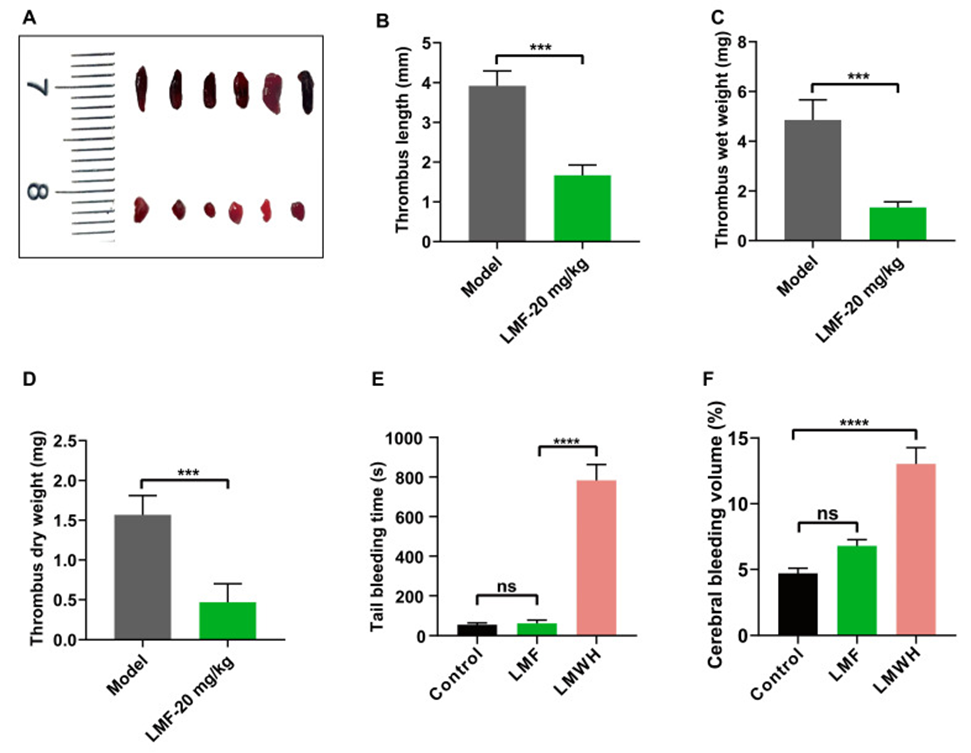
DVT, or deep vein thrombosis, is a condition affecting the peripheral blood vessels. The development of DVT may be further influenced by activated platelets through the promotion of NET formation and elevated S100A8/A9 levels. In experiments using an inferior vena cava ligation model, significant inhibition of thrombus formation was observed in mice treated with LMF (Figures 3A-D). Moreover, tests involving tail bleeding (as depicted in Figure 3E) and a collagenase-induced cerebral hemorrhage model (also visible in Figure 3F) demonstrated that LMF, at the dosage used for DVT treatment, does not heighten the likelihood of bleeding. These results suggest that LMF can alleviate DVT without increasing the risk of bleeding.
In summary, the research found that the alarmin protein S100A8/A9 is a new target for LMF. The findings indicate that LMF played a crucial role in ameliorating deep vein thrombosis (DVT) by substantially reducing S100A8/A9-induced platelet activation and subsequent NET formation. LMF shows significant promise as a therapy to reduce thrombosis and inflammation induced by S100A8/A9.
Source: Mar Drugs. 2025 Apr 22;23(5):180. doi: 10.3390/md23050180