
Low-molecular-weight fucoidan (LMF) is a common nutritional supplement for individuals undergoing cancer treatment. It is important to note that the current body of clinical evidence is not yet considered robust, given that all preceding research has been restricted to in vitro (test-tube) experiments or studies that utilized mice. Accordingly, this blog post introduces a study titled “Efficacy of Low-Molecular-Weight Fucoidan as a Supplemental Therapy in Metastatic Colorectal Cancer Patients: A Double-Blind Randomized Controlled Trial,” by Hsiang-Lin Tsai et al. The goal of this study is to determine the effectiveness of LMF as an additional treatment option for mCRC patients, complementing chemotherapy and molecular-targeted therapy.
The initial phase of our research involved the execution of a prospective, randomized, double-blind, controlled trial, meticulously crafted to ascertain the efficacy of LMF when utilized as an adjuvant therapy in conjunction with both chemotherapy and molecular-targeted therapy for patients suffering from metastatic colorectal cancer (mCRC). The study enrolled 60 mCRC patients who met the eligibility criteria. Ultimately, 54 patients were enrolled in the trial, comprising 28 patients in the study group and 26 in the control group. The primary endpoint was the disease control rate (DCR), while secondary endpoints included the overall response rate (ORR), progression-free survival (PFS), overall survival (OS), adverse events (AEs), and quality of life (QOL).
The study and control groups showed similar demographic features. These included gender, age, whether they had metachronous or synchronous metastatic colorectal cancer, the length of median follow-up, whether a metastasectomy was performed, and pretreatment lab results. The lab values that were comparable were white blood cell count, platelet count, hemoglobin level, alanine aminotransferase level, creatinine level, carcinoembryonic antigen level, and body weight.
The disease control rate (DCR), defined as the sum of CR, PR, and SD, was significantly higher in the study group than in the control group (an increase of 23.6%).
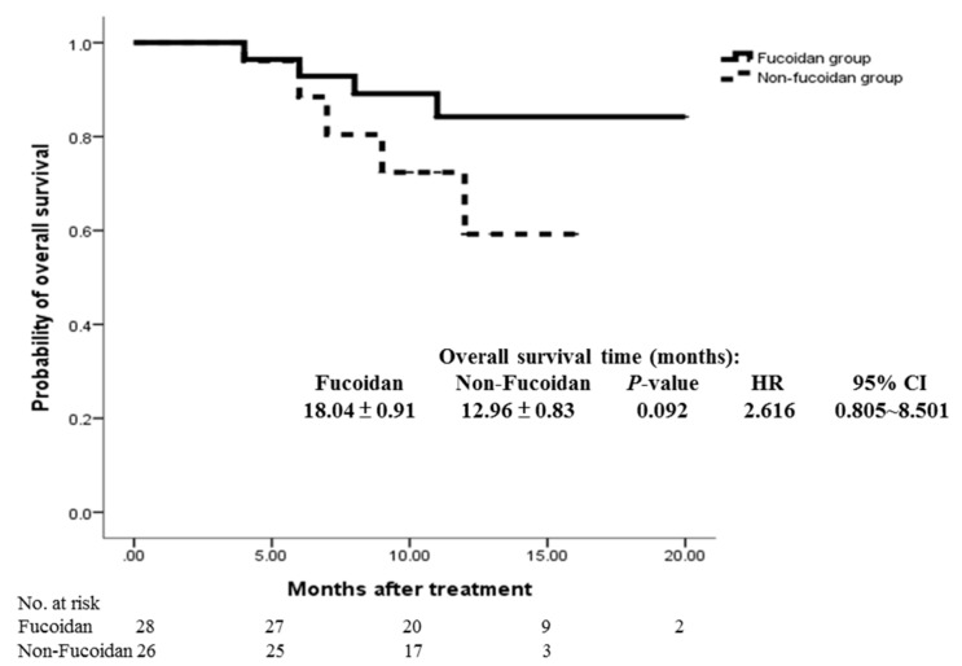
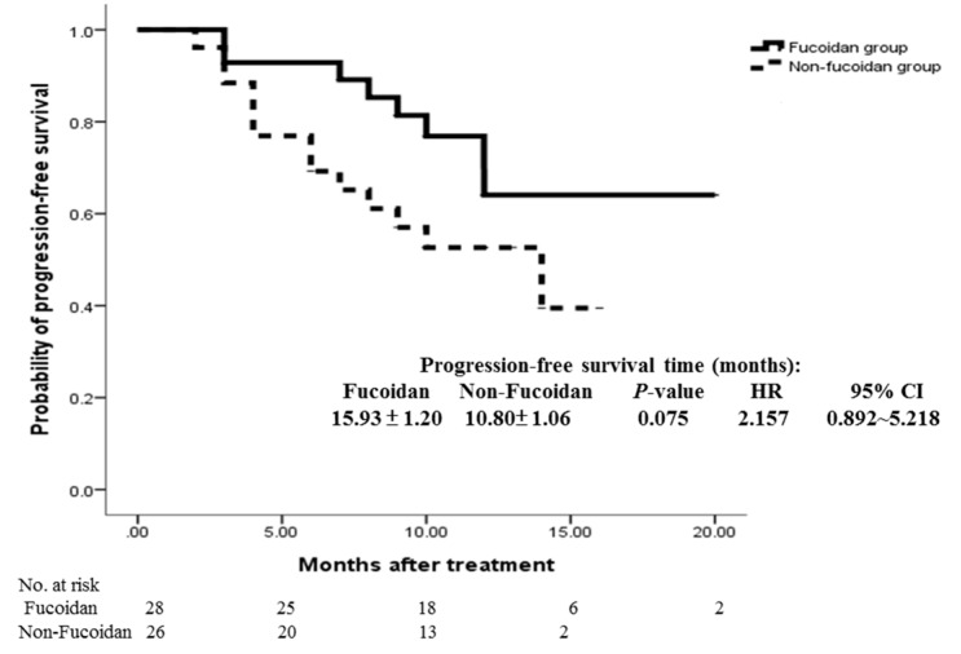
The ORR (sum of CR and PR rates) was comparable between the test group and the control group (60.7% vs. 46.2%; p = 0.284; Table 2). Compared with the control group, the test group showed a trend toward improvement in OS (18.04 ± 0.91 vs. 12.96 ± 0.83 months; p = 0.092) and PFS (15.93 ± 1.20 vs. 10.80 ± 1.06 months; p = 0.075); however, the differences were not statistically significant (Figures 1 and 2).
During the study period, no serious adverse events (AEs) were observed in either group. Furthermore, no treatment discontinuations attributed to drug-related adverse events were reported. No deaths associated with fucoidan treatment were observed. The targeted chemotherapy given to the two groups was similar in terms of its duration and intensity.
The degree of divergence observed across all foundational hematological measurements exhibited a comparable pattern between the two distinct groups. The grading of leukopenia, anemia, and thrombocytopenia also showed a similar distribution. In addition, the control group displayed a tendency towards higher occurrences of oral mucositis, pruritus, vomiting, dysgeusia, and bloody stools than the study group; however, these disparities did not achieve statistical significance.
In terms of limitations experienced in daily activities, difficulties with walking, feelings of anxiety, persistent fatigue, general weakness, and challenges with personal hygiene, the two groups demonstrated a notable degree of similarity. No significant differences were observed between the control and test groups regarding Grade 3 events, including limitations in hobby-related activities, sleep disturbances, and depressive symptoms.
Based on the evidence presented in this research, it appears that the combined administration of LMF alongside chemotherapy and molecular-targeted therapy is associated with a statistically significant improvement in the disease control rate (DCR). In addition, by illustrating how LMF enhances disease management, our research offers groundbreaking perspectives for advancing cancer therapies. This is especially relevant for combination treatments that integrate natural or herbal remedies with chemotherapy and targeted medications.
Source: Mar Drugs. 2017 Apr 21;15(4):122. doi: 10.3390/md15040122