Brown algae-derived polysaccharides have protective properties that help guard the intestine—which is the body’s largest digestive and immune organ—against metabolic diseases and damage to its barrier. While digesting and absorbing nutrients, it also significantly contributes to immune function. Studies have demonstrated that oxidative stress, inflammation, damage to the intestinal barrier, and imbalances in gut microbiota can contribute to a range of intestinal disorders as well as other health problems.
Brown algae-derived polysaccharides have garnered significant attention as food-derived natural compounds that combine excellent biological activity with low toxicity and minimal side effects. Studies have demonstrated that these polysaccharides can repair damage to the physical, chemical, immunological, and biological barriers of the intestine. This blog post highlights the study “Research Progress on the Protective Effect of Brown Algae-Derived Polysaccharides on Metabolic Diseases and Intestinal Barrier Injury” by Ying Yang et al. The study details the ability of brown algae-derived polysaccharides to maintain intestinal barrier integrity, inhibit damage associated with lipid peroxidation, and suppress inflammatory cytokines, while also explaining the protective effects they offer for gut health and the underlying mechanisms involved.
Many factors influence gut health. Inflammation, medication use, lipid peroxidation, and damage to the intestinal barrier can all contribute to conditions associated with intestinal inflammation. Activation of the NF-κB (nuclear factor-kappa B) and MAPK (mitogen-activated protein kinase) pathways promotes the secretion of inflammatory cytokines (such as TNF-α, NO, iNOS, COX-2, IL-1β, and IL-6) by T cells, B cells, and monocytes. Excessive accumulation of reactive oxygen species (ROS) stimulates the production of inflammatory cytokines by immune cells, leading to oxidative stress and inflammation. This also stimulates signaling pathways such as MAPK, PKC, JNK, and ERK, causing tight junction (TJ) complexes between epithelial cells to break down and thereby weakening the intestinal epithelial barrier function.
Polysaccharides derived from brown algae not only promote the synthesis of transmembrane proteins in intestinal epithelial cells but also modulate the gut microbiota and suppress inflammatory responses, thereby playing a protective and regulatory role against intestinal barrier damage and inflammation.
Defects in intestinal barrier function can lead to chronic and persistent immune activation, contributing to the onset and pathogenesis of numerous diseases, including celiac disease, colorectal cancer, inflammatory bowel disease (IBD), obesity, and diabetes. Therefore, keeping the intestinal barrier intact plays a key role in defending gut health and stopping disease.
The physical barrier of the intestinal tract is composed of intestinal epithelial cells (IECs) and intercellular junctions—specifically adherens junctions (AJs), bridging granules, and tight junctions (TJs). TJs are junctional complexes located at the outermost layer of the luminal (apical) side and consist of intracellular plaque proteins. These proteins seal the gaps between cells and regulate the selective transport of ions and solutes via the paracellular pathway. TJ function is controlled by multiple intracellular signaling pathways. In addition, TJs are associated with the cytoskeleton that reinforces the epithelial cells, forming a dynamic barrier system consisting of IECs. TJs are critical intercellular structures; their disruption—and the consequent increase in paracellular permeability—plays a central role in the pathogenesis of inflammatory bowel disease (IBD). Additionally, greater villus length and shallower crypt depth are associated with higher digestive and absorptive capacity. Research has also shown that fucoidan promotes intestinal motility, thereby contributing to the relief of constipation, improvements in small intestinal tissue morphology, and the repair of tissue damage in IECs.
Matayoshi et al. conducted a double-blind, randomized clinical trial to investigate the constipation-relieving effects of dried Cladosiphon okamuranuz (Okinawa mozuku) powder. The results demonstrated that Cladosiphon okamuranus increased defecation frequency and modulated intestinal function in patients suffering from constipation.
According to Xue et al., fucoidan intake improves the morphology of small intestinal villi in rats suffering from mammary cancer and elevates tight junction (TJ) protein levels along with the phosphorylation levels of ERK1/2 and p38 MAPK in their jejunal tissue. It has also been shown that fucoidan significantly reduces paracellular permeability and strengthens intestinal barrier function by upregulating the expression of claudin-1, occludin, and ZO-1. Alginate oligosaccharides found in fucoidan increased occludin levels in TNF-α-treated IPEC-J2 cells, thereby alleviating inflammatory damage in intestinal epithelial cells. Therefore, brown seaweed-derived polysaccharides can ameliorate damage to the intestinal physical barrier by upregulating the expression of transmembrane proteins, activating signaling pathways involved in tight junction (TJ) regulation, and reducing paracellular permeability.
Various substances make up the chemical barrier of the intestinal tract, including digestive fluids, bile acids, antimicrobial peptides (AMPs), mucins, and other compounds released from intestinal epithelial cells (IECs) into the intestinal lumen to block bacterial adhesion. Goblet cells secrete mucins to form a dense gel layer covering the intestinal mucosa, thereby preventing bacterial invasion. The small intestine and colon contain MUC2 as their most plentiful mucin. When there is a deficiency of it, the host becomes more vulnerable to invasion by harmful bacteria, experiences changes in the mucus layer along with problems in AMP function, and this can lead to disease by causing bacteria to move from the gut into the body because of a rise in intestinal permeability.
Supplementation with brown algae-derived polysaccharides promoted the expression of intestinal mucins. Furthermore, these polysaccharides bind to bile acids, inhibiting their reabsorption and stimulating hepatic cholesterol metabolism. Research findings suggest a correlation between the bile acid-binding properties of these polysaccharides and the sulfate groups they possess.
The intestinal tract constitutes the largest immune system in the body, with gut-associated lymphoid tissue (GALT) serving as a key component responsible for 70% of systemic immune function. Intestinal immune cells include T cells, B cells, innate lymphoid cells (ILC1, ILC2, ILC3), and the mononuclear phagocyte system (monocytes, dendritic cells [DCs], and macrophages). These immune cells produce and secrete various pro-inflammatory and anti-inflammatory cytokines and enzymes to regulate inflammation and immune responses. Secretory immunoglobulin A (sIgA) is produced primarily by lymphocytes and plasma cells distributed across the intestinal mucosal surface; it acts as a major factor in preventing pathogen invasion and plays a crucial role in the intestinal immune system.
Fucoidan exhibits bidirectional immunomodulatory effects—capable of both immune enhancement and suppression. In the intestine, pattern recognition receptors (PRRs)—such as Toll-like receptors (TLRs) and NOD-like receptors (NLRs)recognize polysaccharides; this specific recognition activates signaling pathways that regulate inflammation and immune cytokines, potentially leading to the upregulation of relevant gene expression and protein synthesis. Through these mechanisms, fucoidan is believed to modulate intestinal immunity and protect the intestinal immune barrier when it is compromised. One of the elements that causes the intestinal barrier to become impaired is oxidative stress. Indeed, oxidative stress resulting from the accumulation of reactive oxygen species (ROS) underlies the pathogenesis of numerous intestinal disorders. Oxidative stress can impair intestinal epithelial barrier function by disrupting intercellular tight junction (TJ) complexes and inducing the redistribution of TJs and adheres junctions (AJs) via multiple signaling pathways, including PKC, MAPK, JNK, and ERK.
Fucoidan obtained from Fucus vesiculosus (FVF) has demonstrated the ability to lower intracellular reactive oxygen species (ROS) levels and ease insulin resistance caused by sodium palmitate, by enhancing glucose consumption through ROS-mediated JNK and Akt signaling pathways. Additionally, alginate derived from Sargassum fusiform can mitigate oxidative stress to some extent by enhancing the activity of antioxidant enzymes (CAT, SOD) in the serum of mice with high-fat diet-induced diabetes. Therefore, brown algae-derived polysaccharides may protect the intestine against oxidative stress-induced damage by suppressing ROS production and enhancing antioxidant enzyme activity.
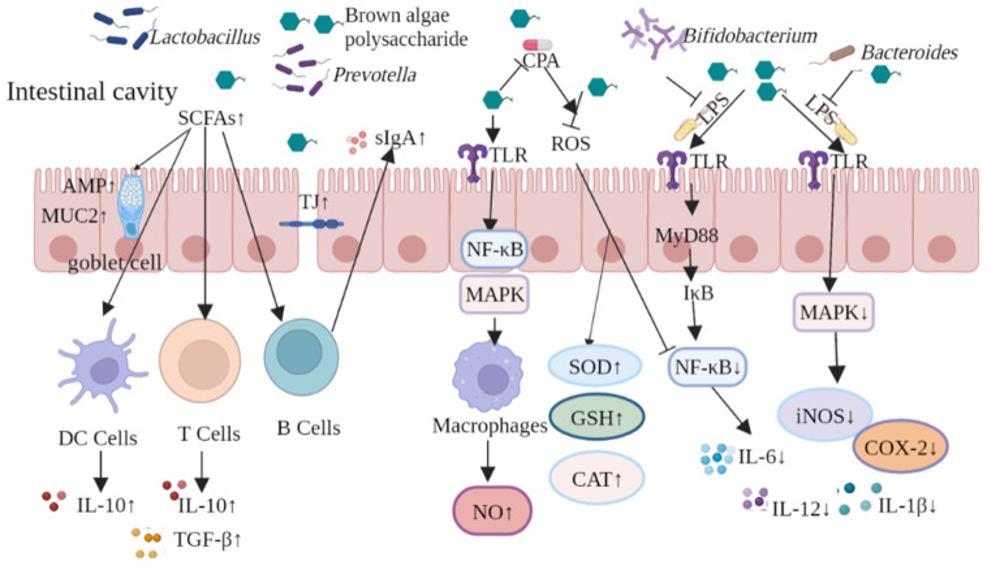
In conclusion, polysaccharides obtained from brown algae have an important function in the prevention and treatment of intestinal diseases through their ability to fix intestinal barrier damage, inhibit lipid peroxidation, and decrease the expression of inflammatory factors. As shown in Figure 1, the protective mechanism against intestinal injury involves using these polysaccharides as prebiotics; they enhance the expression of tight junction (TJ) proteins and maintain the integrity of the physical intestinal barrier, thereby reducing bacterial translocation and pathogen invasion. Brown algae-derived polysaccharides modulate the gut microbiota to increase beneficial bacteria while promoting the production of short-chain fatty acids (SCFAs), antimicrobial peptides (AMPs), and MUC2 by goblet cells.
Furthermore, they strengthen the chemical barrier function of the intestine and stimulate dendritic cells (DCs), T cells, and B cells to produce anti-inflammatory cytokines and antibodies, thereby improving intestinal immunity and reinforcing the microbial barrier. By modulating the NF-κB and MAPK signaling pathways and regulating the expression of inflammatory factors, these polysaccharides can alleviate immunosuppression induced by the chemotherapy drug CPA and act to boost immunity. They also mitigate reactive oxygen species (ROS) production by inhibiting NF-κB pathway activation; this promotes the synthesis of antioxidant enzymes and suppresses inflammatory responses triggered by lipopolysaccharides (LPS). In conclusion, these polysaccharides provide anti-inflammatory benefits by stopping the activation of the NF-κB and MAPK signaling pathways and by reducing the production of pro-inflammatory cytokines.
Source: Int J Mol Sci. 2022 Sep 15;23(18):10784. doi: 10.3390/ijms231810784