
In this blog, I would like to inform of you the study, “Undaria pinnatifida Fucoidan Enhances Gut Microbiome, Butyrate Production, and Exerts Anti-Inflammatory Effects in an In Vitro Short-Term SHIME® Coupled to a Caco-2/THP-1 Co-Culture Model” by Barbara C Wimmer et al that elucidated in detail the effects of fucoidan derived from *Undaria pinnatifida* (UPF) on the colonic microbiota.
First, the study conducted a three-week intervention using fecal samples from three healthy donors; they evaluated the metabolic activity of the colonic microbiota by quantifying short-chain fatty acids and analyzed the microbiota composition via Illumina sequencing targeting the 16S rRNA gene.
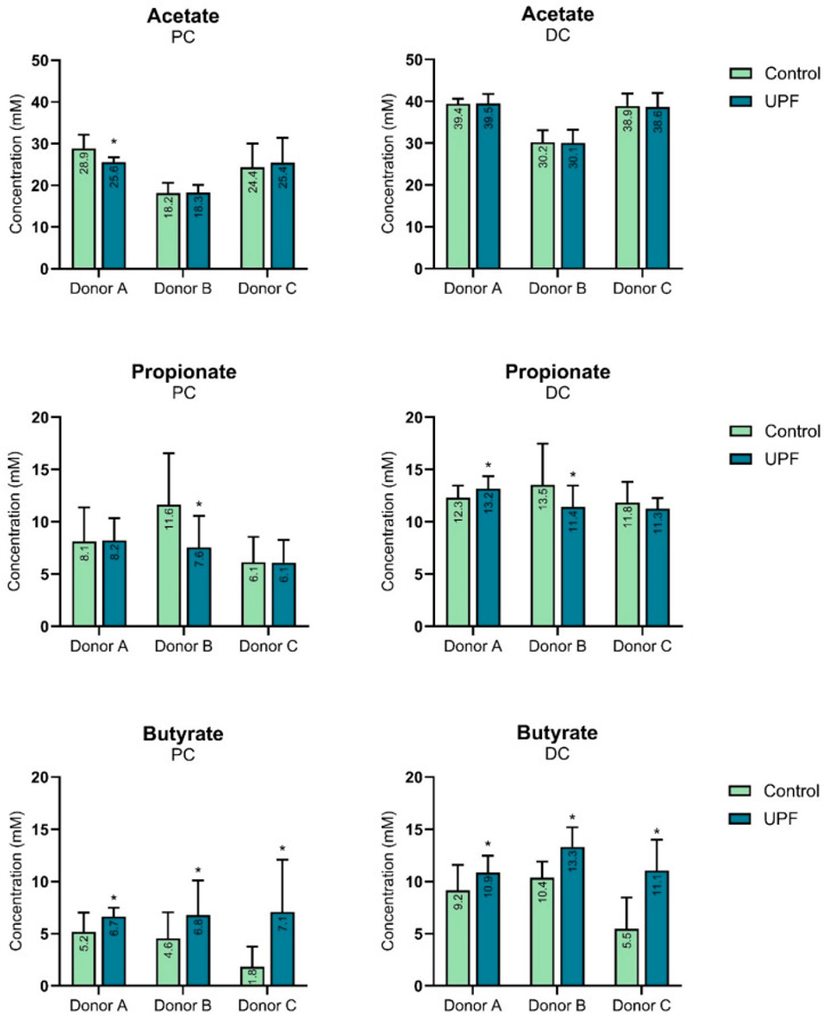
Overall, the addition of UPF had little effect on acetate concentrations in the proximal and distal colon across all donors, with the exception of a decrease observed in the proximal colon of Donor A (Figure 1). Regarding propionate concentrations, inter-donor variability was observed following UPF addition; concentrations decreased significantly in both colon regions for Donor B, whereas they increased in the distal colon for Donor A (Figure 1). In contrast, butyrate concentrations increased significantly in both the proximal and distal colon of all donors upon the addition of UPF (Figure 1).
The effects of UPF on alpha diversity in the proximal and distal colon were evaluated for the three donors, both individually and as a group. Four metrics were calculated to assess alpha diversity: the number of observed taxa, the Chao1 index, the Shannon index, and the Simpson index. Following UPF intake, significant increases in the number of observed taxa and the Chao1 index were observed in both colon regions across the donor group, indicating enhanced species richness. Furthermore, a significant increase in the Shannon index was observed in the distal colon across the donor group. Additionally, in the distal colon of Donor B, both the Shannon and Simpson indices showed significantly higher values post-treatment. These findings suggest that UPF exerted a beneficial effect on bacterial distribution.
Also, differences in beta diversity, as assessed by principal component analysis (PCA), demonstrated that the addition of ultra-processed foods (UF) had a distinct impact on microbial diversity. In the proximal colon, shifts along the principal component axes were observed across all donors following treatment; Donor B exhibited the greatest shift along the first principal component axis, indicating the strongest impact. In the distal colon, shifts along the principal component axes were observed for Donors B and C, whereas for Donor A, the treatment and control groups clustered in proximity, suggesting greater similarity between the microbial communities of the two groups for this donor.
Linear Discriminant Analysis Effect Size (LEfSe) and treeclimbR analyses were employed to identify bacterial groups involved in changes to the microbiota composition within the colonic environment. These analyses identified genera showing significant differences between UF (ultra-processed food) supplementation and control conditions, both across donors and within individual donors (proximal and distal colon). In the inter-donor analysis, LEfSe results linked UPF supplementation to a statistically and biologically significant increase in the genera *Bilophila* and *Lysinibacillus* in the proximal colon; treeclimbR analysis also indicated an increase in *Lysinibacillus*. However, while donors A and C showed no changes in *Bilophila* abundance, the significant shift observed in donor B was the primary driver of the significant results found in the aggregate analysis.
The genera *Pseudomonas*, *Blautia*, *Dorea*, and *Agathobacter*, as well as an unidentified genus within the family Veillonellaceae and the phylum Proteobacteria, increased significantly in a statistical sense due to UPF, though they did not reach the threshold for biological significance. Conversely, the genera *Anaeroglobus* and *Parabacteroides* increased at levels of biological relevance, even though they did not reach statistical significance. The genera *Bacteroides* and *Veillonella*, along with the family Selenomonadaceae, decreased both biologically and statistically following UPF treatment. Additionally, the genus *Klebsiella* showed a statistical decrease, while the genus *Phascolarctobacterium* showed a biological decrease.
In the inter-donor analysis for the distal colon, LEfSe and/or treeclimbR analyses revealed that the genera *Eisenbergiella* and *Hungatella*, the *Eubacterium ventriosum* group, and an unidentified genus within the family Lachnospiraceae increased both biologically and statistically in response to UPF supplementation. Furthermore, the genera *Alistipes*, *Sellimonas*, *Anaerotruncus*, and *Monoglobus*, as well as *Lachnospiraceae* UCG-004 and an unidentified genus of the family Enterobacteriaceae, showed a statistically significant increase with the addition of UPF, but did not reach biological significance.
UPF administration resulted in a statistically and biologically significant decrease in *Megasphaera*, *Akkermansia*, and *Veillonella*; meanwhile, *Fusobacterium* decreased at a biologically significant level, though no statistical significance was observed. However, the abundance of *Akkermansia muciniphila* varied greatly among donors; UPF administration reduced *Akkermansia* abundance in Donor C, whereas no effect was observed in Donor A.
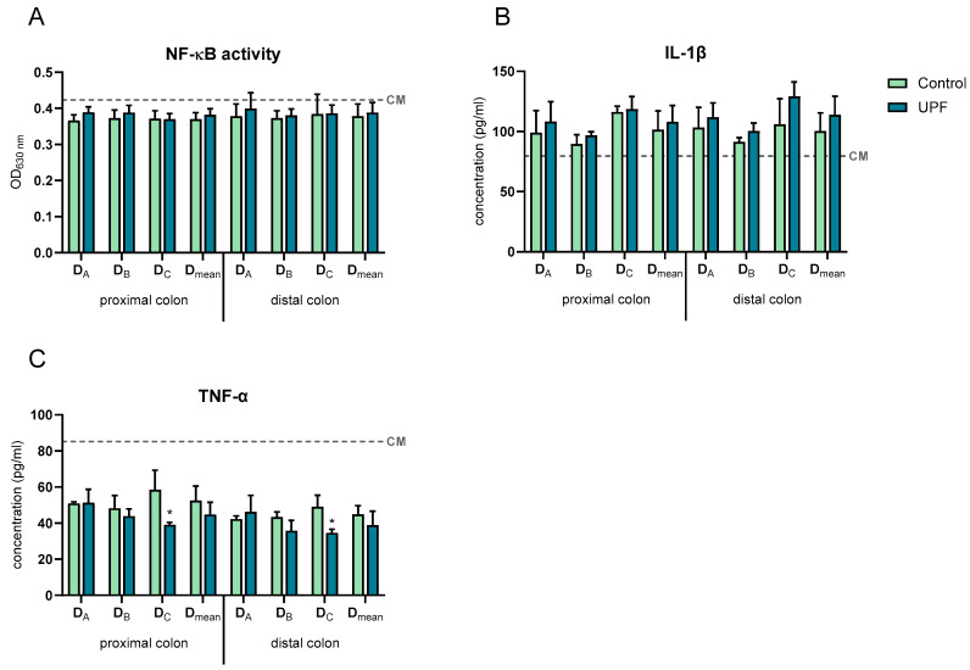
After 24 hours of incubation, a slight decrease in NF-κB (nuclear factor kappa-light-chain-enhancer of activated B cells) activity and an increase in the inflammatory cytokine IL-1β (interleukin-1β) were observed in all SHIME samples compared to the complete medium (CM) control (Figure 2). However, the addition of UPF did not significantly affect NF-κB activity or IL-1β levels in either colon region across all donors compared to their respective controls.
After 24 hours, a decrease in the secretion of the inflammatory cytokine TNF-α (tumor necrosis factor-alpha) was observed in all SHIME samples compared to the CM control (Figure 2). Furthermore, for Donor C, the addition of UPF resulted in a significant reduction in TNF-α secretion in both the proximal and distal colon compared to the control. When considering all donors, no significant difference was observed between UPF and the control in either colon region.
Secretion levels of the inflammatory chemokines CXCL10, MCP-1, and IL-8 decreased in all SHIME samples compared to CM. Additionally, UPF treatment did not significantly affect CXCL10 secretion levels in the proximal or distal colon across all donors compared to the control. In contrast, for Donor C, UPF treatment significantly reduced IL-8 secretion in the proximal colon and MCP-1 secretion in the distal colon compared to the control. However, when considering all donors, no significant differences were observed between the treatment and control regarding the secretion levels of CXCL10, MCP-1, and IL-8.
In all SHIME samples, secretion levels of the anti-inflammatory cytokines IL-6 and IL-10 increased compared to the control supplemented with LPS (lipopolysaccharide). Furthermore, in the proximal colon, UPF treatment induced the secretion of IL-6 and IL-10 in donors A and C; consequently, significant differences compared to the control were observed for both IL-6 and IL-10 in donor C, and for IL-6 in donor A. In the distal colon, the treatment significantly increased the secretion of the anti-inflammatory cytokines IL-6 and IL-10 in donors B and C compared to the control. Across all donors, UPF treatment resulted in a significant increase in IL-6 concentrations in both the proximal and distal colon.
Three weeks of UPF administration significantly promoted butyrate production and increased colonic microbiota diversity. Furthermore, UPF consistently stimulated the growth of saccharolytic genera while reducing genera potentially detrimental to health in both the proximal and distal colon. Mild immunomodulatory effects were also observed; colonic fermentation of UPF exhibited anti-inflammatory properties, inducing the secretion of anti-inflammatory cytokines (IL-6 and IL-10) in both the proximal and distal colon in two out of three donors. These findings suggest that UPF intake may have beneficial effects on maintaining a healthy gut environment.
Source: Mar Drugs. 2025 Jun 4;23(6):242. doi: 10.3390/md23060242