
In vitro research extensively demonstrates fucoidan’s anticoagulant capabilities; however, human studies have failed to consistently replicate these anticipated effects, often reporting minimal to no significant alterations in the coagulation cascade.
Therefore, in this blog, I would like to inform you of the study, “Evaluation of the effects of fucoidan extracted from sargassum angustifolium on coagulation factors and biochemical parameters in male Wistar rats” by Asma Dehghani et al.
The effects of fucoidan extracted from Sargassum angustifolium on particular coagulation determinants, such as prothrombin time (PT), thrombin time (TT), and partial thromboplastin time (PTT), were evaluated. Concurrently, biochemical parameters including total protein, glucose, transferrin, iron, ferritin, and albumin were assessed in male Wistar rats.
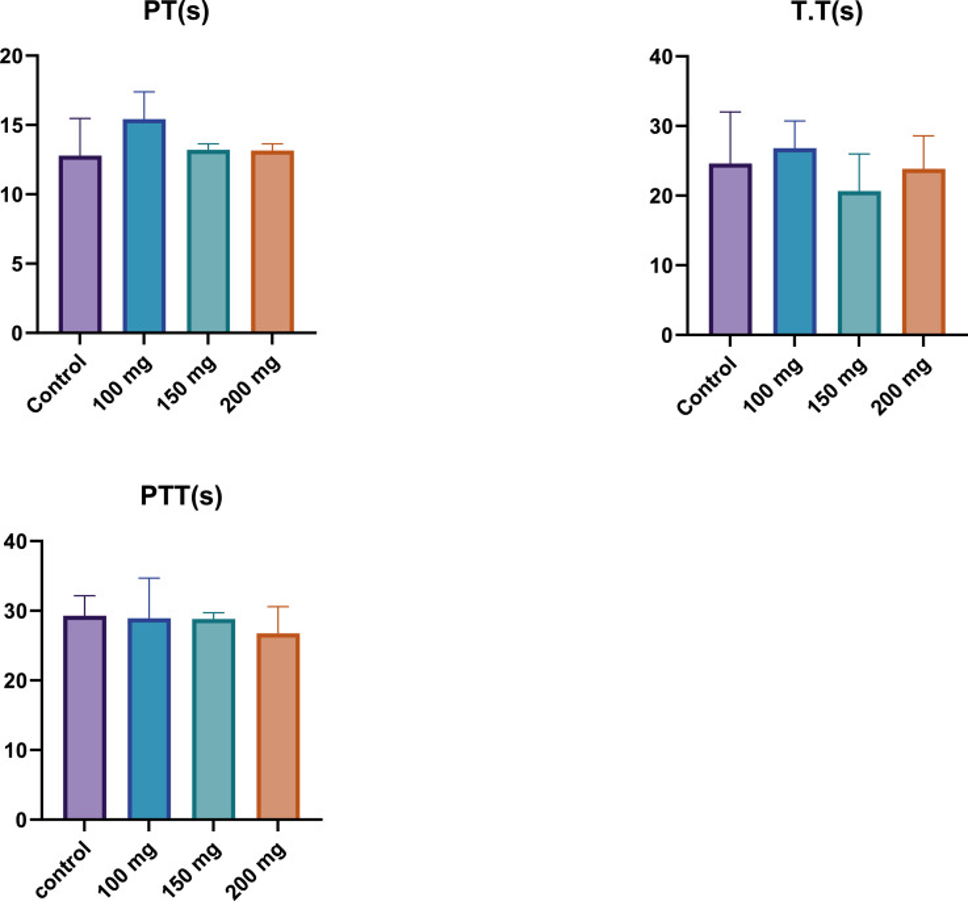
Prothrombin time (PT) is an important parameter for evaluating the extrinsic pathway of coagulation. First, in the study, PT values were measured in a control group and fucoidan-treated groups at varying doses. As shown in Figure 1, although slight variations in PT were observed between groups, these differences were not statistically significant. The 200 mg/kg BW (body weight) fucoidan-treated group had a slightly higher PT compared to the control group and the low-dose fucoidan-treated group. However, the overall consistency of PT values suggests that the administered doses of fucoidan did not significantly alter the extrinsic pathway.
TT is a measure of the time it takes for thrombin to convert fibrinogen to fibrin, a critical step in the final stage of the coagulation cascade. As shown in Figure 1, the TT results showed little variation between the control and fucoidan-treated groups. All groups showed similar TT values, indicating that fucoidan administration did not significantly affect this coagulation parameter. This result suggests that fucoidan does not significantly affect thrombin-mediated fibrinogen-to-fibrin conversion, an essential component for clot formation.
PTT is an index used to evaluate the intrinsic and common pathways of coagulation. As shown in Figure 1, the control group showed the highest PTT values, while the fucoidan-treated groups showed a slight dose-dependent decrease in PTT values. Among the fucoidan-treated groups, the 200 mg/kg group showed the lowest PTT values, indicating a slight reduction in the time required for clot formation via the intrinsic pathway. Despite these observations, the differences between groups were small and may not be statistically significant. Therefore, fucoidan administration appears to have a mild, but not significant, effect on the intrinsic coagulation pathway.
Total protein levels reflect the balance between protein synthesis and breakdown and are an important indicator of overall health and nutritional status. When total protein levels were measured in the control and fucoidan-treated groups, the results showed comparable protein levels in all groups, with no significant differences between the control group and groups treated with various fucoidan doses. These results suggest that fucoidan treatment does not significantly affect the rats’ overall protein metabolism or synthesis, maintaining consistent total protein concentrations across different treatment groups.
Glucose levels were also measured as a crucial biochemical parameter, taking into account the known metabolic effects of fucoidan. A significant dose-dependent decrease in glucose levels was observed in the fucoidan-treated groups compared to the control group. Specifically, the 150 mg/kg BW and 200 mg/kg BW fucoidan-treated groups showed statistically significant decreases in glucose levels compared to the control group. The 200 mg/kg BW group showed the most significant decrease in glucose concentrations, suggesting that fucoidan may be effective as a hypoglycemic agent. This dose-dependent hypoglycemic effect suggests that fucoidan may affect glucose metabolism and have therapeutic potential for diseases characterized by hyperglycemia, such as diabetes.
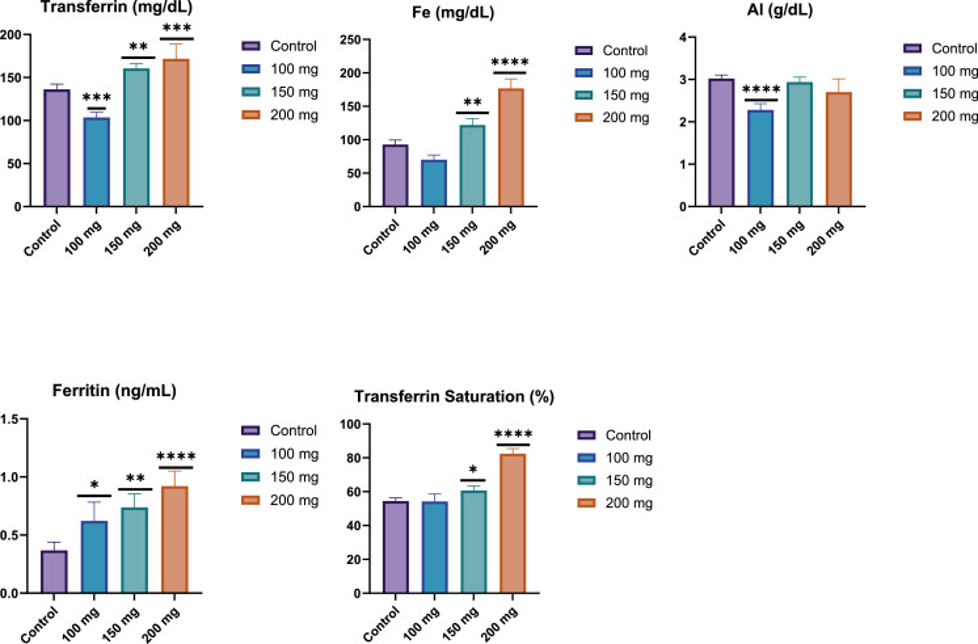
The results show that transferrin (a blood protein that binds to and transports iron) concentrations increased dose-dependently with increasing fucoidan dose. The 200 mg/kg BW group had a significantly higher transferrin concentration compared to the control group. While the 100 mg/kg BW group had a slight decrease, the 150 mg/kg BW and 200 mg/kg BW groups had a progressive increase in transferrin concentration.
Serum iron (Fe) concentrations demonstrated a dose-dependent response to fucoidan administration. Specifically, the group administered 150 mg/kg BW of fucoidan had a statistically significant increase in serum iron concentration compared to the control group. Furthermore, the 200 mg/kg BW group had an even more pronounced increase in serum iron concentration, demonstrating a highly significant difference compared to the control group. These results suggest that fucoidan may promote iron absorption and storage at high doses (Figure 2).
Fucoidan administration resulted in a dose-dependent increase in ferritin levels (a protein that stores iron). The 200mg/kg BW group showed the most significant increase, followed by the 150mg/kg BW and 100mg BW groups. This suggests that high dose fucoidan administration leads to increased ferritin production or storage (Figure 2).
All study groups showed a dose-dependent rise in transferrin saturation. The 150mg/kg BW group showed a significant increase compared to the control group, and the 200mg/kg BW group showed a highly significant increase. The 100mg/kg BW group showed no significant change compared to the control group. These findings suggest that high-dose fucoidan may promote iron transport and absorption (Figure 2).
The graph shows the change in albumin levels (a protein made by your liver) at different fucoidan doses. The 100 mg/kg BW fucoidan group showed a significant decrease in albumin levels compared to the control group. Although the 150 mg/kg BW and 200 mg/kg BW groups also showed lower albumin levels compared to the control group, the differences were less pronounced and not statistically significant. This suggests that fucoidan, especially at low doses, may affect albumin production or metabolism (Figure 2).
These results indicate that fucoidan administration significantly affects iron metabolism and related parameters. The observed increases in transferrin, iron, and ferritin levels suggest that fucoidan may enhance iron absorption, transport, or storage in a dose-dependent manner.
The results of the study demonstrated that fucoidan at the administered dose did not significantly alter the prothrombin time (PT), thrombin time (TT), and partial thromboplastin time (PTT) in Wistar rats. This discrepancy between in vitro and in vivo effects may be due to several factors. In the complex biological environment of the body, fucoidan may undergo metabolic modifications, potentially reducing its interaction with coagulation factors.
Fucoidan sourced from Sargassum, while not appearing to have significant anticoagulant action in vivo at 100, 150, and 200 mg/kg body weight, offers a favorable coagulation safety profile and possesses beneficial qualities including hypoglycemic, anticancer, anti-inflammatory, and antioxidant activities, positioning it as a promising substance for the creation of innovative therapeutic strategies.
Source: Hematol Transfus Cell Ther. 2025 Oct 30;48(1):106073. doi: 10.1016/j.htct.2025.106073